
Computer Integrated Manufacturing (CIM)
Computer Integrated Manufacturing (CIM) represents the complete fusion of digital engineering, automation, and manufacturing into a unified cyber-physical environment. In the Industry 5.0 context, CIM shifts from pure automation towards human–machine collaboration, AI-enhanced decision-making, and smart, adaptive production modules. Computer Integrated Manufacturing (CIM) represents the complete fusion of digital engineering, automation, and manufacturing into a unified cyber-physical environment. In the Industry 5.0 context, CIM shifts from pure automation towards human–machine collaboration, AI-enhanced decision-making, and smart, adaptive production modules.
A modern CIM laboratory enables universities and technical institutes to simulate real industrial workflows — from CAD design to machining, assembly, inspection, and data-driven optimization. The system integrates CNC technology, robotics, material handling, IoT sensors, digital twin models, AGVs, vision inspection, and AI-assisted scheduling. A modern CIM laboratory enables universities and technical institutes to simulate real industrial workflows — from CAD design to machining, assembly, inspection, and data-driven optimization. The system integrates CNC technology, robotics, material handling, IoT sensors, digital twin models, AGVs, vision inspection, and AI-assisted scheduling.
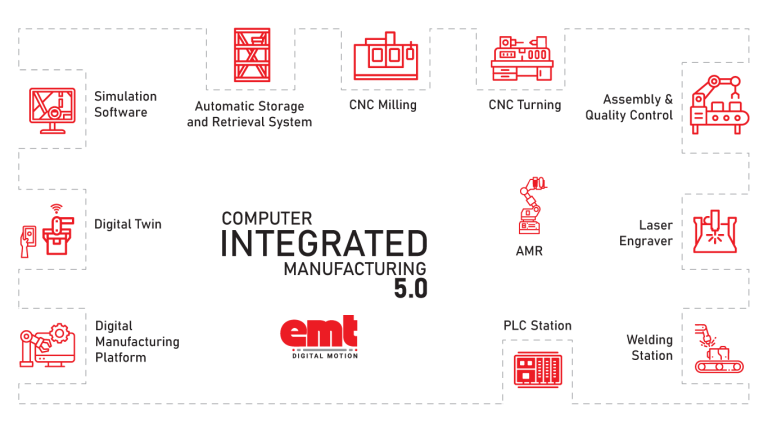
A CIM environment built by EMT Global provides students with hands-on experience in designing, planning, executing, and optimizing end-to-end manufacturing processes using future-ready tools aligned with Industry 5.0 competencies. A CIM environment built by EMT Global provides students with hands-on experience in designing, planning, executing, and optimizing end-to-end manufacturing processes using future-ready tools aligned with Industry 5.0 competencies.
Key Components
- CAD/CAM Integration – Full digital design to manufacturing workflow.
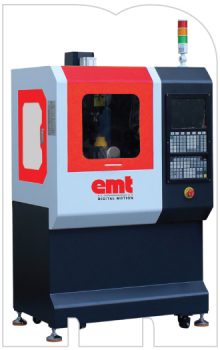
- CNC Turning & Milling Stations – Real industrial CNC education-grade machines.
- Robotic Handling Systems – Pick-and-place, loading / unloading functions.- Robotic Handling Systems
- Automated Storage & Retrieval (AS/RS) – Smart warehousing and inventory logic.
- Flexible Conveying Systems – Intelligent routing for multi-stage production.
- IoT Sensor Networks – Real-time shopfloor monitoring for performance analytics.
- Digital Twin Simulation – Virtual representation of machines, cells, and material flows.
- Manufacturing Execution Software (MES) – Job scheduling, sequencing, performance dashboards.
Learning Outcomes
- Manage complete product life cycle workflows.
- Real-time monitoring and adaptive production control.
- CNC–robot–sensor integration.
- Understanding Industry 5.0 collaborative manufacturing.
- Process planning, layout design, and optimization.
- Exposure to predictive maintenance and quality analytics.
- Builds an industry-aligned Smart Factory Lab
- Enhances engineering programs across multiple disciplines.
- Improves student employability for advanced industries.
- Supports research in Robotics, AI, IIoT, and Digital Twin.
- Enables hackathons, capstone projects, and innovation challenges.